



The SEEDS project continues to make strong progress in the development of smarter and more sustainable heating and cooling solutions for buildings.
Recent work has focused on improving borefield performance and developing advanced control strategies that can help optimise system efficiency, reduce costs and support the wider deployment of low-carbon heating and cooling technologies.
Valuable data from the Belgian pilot site De Schipjes
At the Belgian pilot site De Schipjes, more than one year of glass fiber measurement data is now available from two 125 m deep boreholes. This data provides valuable insight into how the borefield behaves under different operating conditions, including regular heating operation, natural summer regeneration and active regeneration using solar thermal collectors.
These measurements are an important step forward, as they will support the development of more advanced borefield models. In turn, these models will help improve the performance of Model Predictive Controllers (MPC), which are used to make heating and cooling systems more intelligent, responsive and efficient.
Applying the insights to the Stijn Streuvelsstraat replica pilot
The results gathered at De Schipjes are also being applied to the replica pilot Stijn Streuvelsstraat. This site features a split borefield that can switch between passive cooling and active regeneration via PVT.
This approach makes it possible to better understand how different configurations and operating modes can contribute to more efficient energy use in buildings. The borefield and PVT analyses are led by Lone Meertens, supporting the project’s wider objective of connecting real-world data with improved system design and operation.
A new method for smarter system design
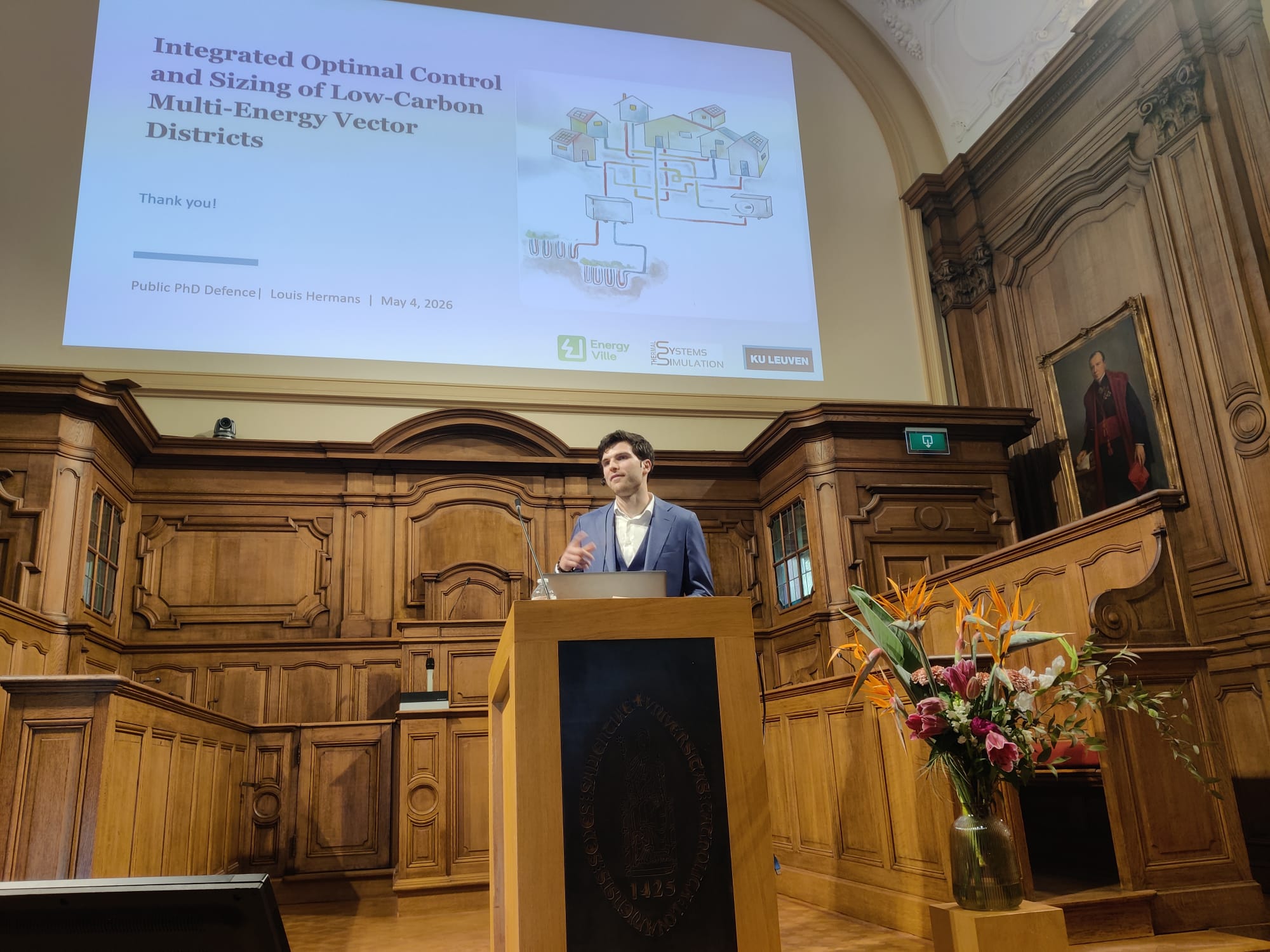
In parallel, the team has developed a novel Integrated Optimal Control and Sizing (IOCS) method. This methodology uses physics-based models to take into account the future behaviour of an optimal model-predictive controller when identifying the best component sizes for a given system.
Applied to the residential pilots De Schipjes and Stijn Streuvelsstraat in a virtual study, the method achieved 20% to 40% reductions in total cost of ownership compared to conventional design and rule-based control approaches. In its first real-world application, IOCS also enabled a 38% reduction in the size of the ground-source heat pump in the Stijn Streuvelsstraat pilot.
These results show the potential of combining smart control, advanced modelling and optimised system sizing to improve the long-term performance and affordability of sustainable heating and cooling systems.
Congratulations to Louis Hermans
The IOCS methodology was developed by Louis Hermans, who recently successfully defended his PhD on this topic. Congratulations on this important achievement!
Through this work, SEEDS continues to support the development of innovative solutions that can help make buildings more energy-efficient, cost-effective and sustainable.

Comments are closed